Thursday, October 9, 2014
Eight College Essay Pitfalls to Avoid #dadchat
The Top Eight Essay Pitfalls - Essay Edge from Nelnet Marketing on Vimeo.
There are lots of mistakes that can be made when writing an essay or personal statement, but some tend to occur more often than others. In the video above, we take a look at eight of the most common places where people tend to have problems when writing pieces like this. Check it out and learn how to avoid issues like these.

Saturday, September 13, 2014
Book Review - The Art of the College Essay


About the Book
“You can do this,” Glancy tells us. “I’ll show you how.” Face-to-face with a blank page and the pressure of writing the most important essay of their lives—the college essay—students often encounter what successful writing coach and college admissions expert Gabrielle Glancy refers to as that which shall not be named—writer’s block. "Everyone tells you what you should do—tell a story; start in the middle; show don’t tell—but no one tells you how to do it," Glancy explains. Using examples from essays that got students into the colleges of their choice, The Art of the College Essay shows what makes great essays great—and then tells you how to write one. Glancy provides a clear, highly readable, student-tested guide to writing college essays that are so powerful—so gripping, authentic, and real—that the Ad Com can only say yes. Helpful appendices list up-to-date college essay prompts, winning adjectives, grammar tips, trouble-shooting suggestions, and a step-by-step breakdown of the process.
My Take on the Book
What was great about this book was that the author was able to take a student from start to finish creating great personal statements/essays that can be turned into any college. As someone who has worked in College Admission for over 15 years, the writing of our candidates has become more and more challenging, so strong statements always put a smile on my face. That being said the author approaches this topic in a fun way that will engage any student. I found myself even motivated to get out some paper to write up a statement myself! I would also say that even though this book is geared toward the college essay process, the skills the author is teaching transcends this and can really be used for any writing endeavor!
Friday, March 7, 2014
Book Review - The Handbook of Student Affairs Administration

About the Book
What issues and trends affect higher education and student affairs today? In this fully updated handbook, leading experts discuss the answer to this and other essential questions. They provide a definitive reference for student affairs professionals at all levels of administration and management. The handbook offers specific, practical advice as well as broad approaches to planning and problem solving. It contains modernized discussions on such critical topics as institutional mission, institutional governance, understanding campus environments, finance and budgeting, assessment, program planning, staff selection, training and evaluation, and much more.
My Take on the Book
As a Student Affairs Professional, this was a book that really walks you step-by-step through the profession and what we do on a daily basis to support the students that we work with. It is a totally complete resource for all Student Affairs Personnel. I had read an earlier edition of this, and this is even more complete than the last time I read this. I have staff that never studied Student Affairs so this is going to be a great resource that I can draw from to assist them in better serving their students as well as furthering their own professional development in the field. This was well written and a book that I am so glad that I had the opportunity to re-read and experience again.

----------------------------------------
New to the Divadom or to Dad of Divas Reviews?
Please Subscribe to my RSS Feed! Subscribe in a reader
Questions? Drop me a line at dadofdivas@gmail.com
Book Review - FERPA: Clear and Simple

About the Book
Family Educational Rights and Privacy Act (FERPA) compliance has always been challenging due to complex regulatory language and exposure to risk. However, institutions that do not comply are in jeopardy of losing federal funding. Accessible and user-friendly, FERPA Clear and Simple clarifies the regulations and provides a ready reference for compliance and problem solving. This need-to-have guide offers critical and relevant material (including the 2008 Amendments) from a new perspective to help staff in student affairs, academic departments, and administrative support positions understand and comply with FERPA guidelines.
My Take on the Book
As a college administrator this is an amazing book that walks you through every aspect of understanding the Family Education Rights and Privacy Act (FERPA). As someone that deals with students daily, I need to be able to maneuver around this act too and sometimes it is a bit unclear. This book completely cleared up so many points that I was a bit hazy on. The book is an amazing resource that I know that I can come back to whenever I need to to better understand what I need to know for the situation that I am dealing with at the point.
The authors of this book have provided clear explanations and examples that you can easily put to work at your own institution. I know for me I have already shared this with my colleagues at my university and I know that I will be keeping this in my own professional library for the foreseeable future!
----------------------------------------
New to the Divadom or to Dad of Divas Reviews?
Please Subscribe to my RSS Feed! Subscribe in a reader
Questions? Drop me a line at dadofdivas@gmail.com
Monday, July 22, 2013
Book Review - How to Prepare a Standout College Application
All opinions expressed in this review are my own and not influenced in any way by the company. Any product claim, statistic, quote or other representation about a product or service should be verified with the manufacturer or provider. Please refer to this site's Disclaimer for more information. I have been compensated or given a product free of charge, but that does not impact my views or opinions.

About the Book
Demystifying the process of completing a college application is what How to Prepare a Standout College Application is all about.
Written by two former admissions officers at top universities and current admissions coaches this book is a must-have for preparing a winning college application. The authors reveal the mystery behind what college admissions officers are looking for and show applicants how to leverage their credentials, stand out in the over-crowded applicants' pool, and make a genuine, memorable impression. This is the book that will help the college-bound get off the "like many others" pile and onto the acceptance list.
Includes instructions and examples for every component of the college application, from writing the essay to answering questions like "Why do you want to go to College X?"
Shows how to avoid underestimating the importance of critical features on any application
Includes the latest information on the Common Application 4.0 and corrects outdated, holdover advice still stressed in many other books
This book is filled with step-by-step advice that students and parents can use immediately and will refer to again and again.
About the Authors
Alison Cooper Chisolm heads the college admissions consulting practice at Ivey Consulting. She came to private consulting after working in admissions for more than 10 years at three selective universities (Southern Methodist University, University of Chicago, and Dartmouth College).
Anna Ivey is the former Dean of Admissions at the University of Chicago Law School and founded Ivey Consulting to help college, law school, and MBA applicants navigate the admissions process and make smart choices about higher education. You can find more college admissions tips in their book How to Prepare a Standout College Application (Wiley, August 2013), and follow them on Twitter @IveyCollege.
My Take on the Book
I have worked in college admissions and higher education for the past 15 years and I am always looking for great books that demystify the process of entering college, as I too wrote my own book on this too. This book takes a little different tact and makes the reader consider the application and what helps to make them stand out from other applicants. As a past College Admissions Officer, I have to say that I know that for many colleges this is important, as colleges are more and more utilizing a holistic approach to admissions. What this means is that there is not just one way in which they are admitting students (GPA or test scores alone), but instead they are looking to have a diverse group of students with a diverse group of experiences that are coming into their academic institution. Thus, it becomes very important to consider these issues as a student as you enter high school and start to make choices that will follow you to your college search and application process.
This book is written in such a way that it makes it easy to set yourself up well to do just that. The book is clear and to-the-point and filled with practical advice that will assist all students with making the right decisions for their future.
The book also is a complete resource and you can tell that it is filled with amazing information that has been collected over time as the authors easily show their ease and expertise in the field itself.
All-in-all this was a great book that shares intimate knowledge of the college admission process and is definitely a book that any high school student or parent should check out today!
----------------------------------------
New to the Divadom or to Dad of Divas Reviews?
Please Subscribe to my RSS Feed! Subscribe in a reader
Questions? Drop me a line at dadofdivas@gmail.com

About the Book
Demystifying the process of completing a college application is what How to Prepare a Standout College Application
is all about.Written by two former admissions officers at top universities and current admissions coaches this book is a must-have for preparing a winning college application. The authors reveal the mystery behind what college admissions officers are looking for and show applicants how to leverage their credentials, stand out in the over-crowded applicants' pool, and make a genuine, memorable impression. This is the book that will help the college-bound get off the "like many others" pile and onto the acceptance list.
Includes instructions and examples for every component of the college application, from writing the essay to answering questions like "Why do you want to go to College X?"
Shows how to avoid underestimating the importance of critical features on any application
Includes the latest information on the Common Application 4.0 and corrects outdated, holdover advice still stressed in many other books
This book is filled with step-by-step advice that students and parents can use immediately and will refer to again and again.
About the Authors
Alison Cooper Chisolm heads the college admissions consulting practice at Ivey Consulting. She came to private consulting after working in admissions for more than 10 years at three selective universities (Southern Methodist University, University of Chicago, and Dartmouth College).
Anna Ivey is the former Dean of Admissions at the University of Chicago Law School and founded Ivey Consulting to help college, law school, and MBA applicants navigate the admissions process and make smart choices about higher education. You can find more college admissions tips in their book How to Prepare a Standout College Application (Wiley, August 2013), and follow them on Twitter @IveyCollege.
My Take on the Book
I have worked in college admissions and higher education for the past 15 years and I am always looking for great books that demystify the process of entering college, as I too wrote my own book on this too. This book takes a little different tact and makes the reader consider the application and what helps to make them stand out from other applicants. As a past College Admissions Officer, I have to say that I know that for many colleges this is important, as colleges are more and more utilizing a holistic approach to admissions. What this means is that there is not just one way in which they are admitting students (GPA or test scores alone), but instead they are looking to have a diverse group of students with a diverse group of experiences that are coming into their academic institution. Thus, it becomes very important to consider these issues as a student as you enter high school and start to make choices that will follow you to your college search and application process.
This book is written in such a way that it makes it easy to set yourself up well to do just that. The book is clear and to-the-point and filled with practical advice that will assist all students with making the right decisions for their future.
The book also is a complete resource and you can tell that it is filled with amazing information that has been collected over time as the authors easily show their ease and expertise in the field itself.
All-in-all this was a great book that shares intimate knowledge of the college admission process and is definitely a book that any high school student or parent should check out today!
----------------------------------------
New to the Divadom or to Dad of Divas Reviews?
Please Subscribe to my RSS Feed! Subscribe in a reader
Questions? Drop me a line at dadofdivas@gmail.com
Monday, June 3, 2013
Book Review - What You Don't Know Can Keep You Out of College
All opinions expressed in this review are my own and not influenced in any way by the company. Any product claim, statistic, quote or other representation about a product or service should be verified with the manufacturer or provider. Please refer to this site's Disclaimer for more information. I have been compensated or given a product free of charge, but that does not impact my views or opinions.

About the Book
In the tradition of The Gatekeepers, a veteran counselor provides the missing key to the college admissions door with insider wisdom about how admissions committees think, and the thirteen fatal mistakes that can ruin an application.
When Don Dunbar was a college counselor for Phillips Academy, Andover, in the 1980s, he got to sit in on the meetings where the nation’s top colleges decided whether to admit his students. Prep school counselors no longer get this kind of astonishing access, but in those meetings, Don discovered a little-known key to college admissions that still holds true today. Many applicants look alike, based on their grades, test scores, and extracurriculars, so colleges want something more: They want applicants with character.
Most of us know what character means, but not in the way that admissions officers define it. Admissions officers have tremendous integrity, and to them, character equals what a student will contribute to his or her community, good or bad, over the next four years. Don explains the concept of character in terms that high school students can understand, using examples from his thirty years of working with kids. He shows readers how to avoid the thirteen fatal character mistakes that even the brightest students make when applying to college and democratizes the admissions process, making his advice available to all students.
My Take on the Book
This was a book that was filled with a ton of advice particularly on how to write essays and how to do your best in the college interview process. Being someone that works in higher education, I found the advice to be sound. I will say that fewer campuses are using the on-campus interview lately, but that being said, the information shared is still good.
The author also talks about some of the mistakes that many students make in their applications and this information is also accurate from what I have seen in applications in the past and currently.
The book is written in such a way that all readers can understand and it is practical enough that you can see what needs to be done to prepare yourself well for the college application process.
Much of the information that is shared is done so through prose and not lists as you may find in other books. While I do not think this is negative, with today's generation of college bound students reading this, some lists would probably have helped to streamline the most important information.
Overall, the book gives the reader some great insights into the selective admissions processes at some institutions. From what I can tell through reading this and knowing colleges out there, the person that will most benefit from this is probably going to be considering a liberal arts institution - as these are the ones that I know that are still heavily using essays and interviews.

About the Book
In the tradition of The Gatekeepers, a veteran counselor provides the missing key to the college admissions door with insider wisdom about how admissions committees think, and the thirteen fatal mistakes that can ruin an application.
When Don Dunbar was a college counselor for Phillips Academy, Andover, in the 1980s, he got to sit in on the meetings where the nation’s top colleges decided whether to admit his students. Prep school counselors no longer get this kind of astonishing access, but in those meetings, Don discovered a little-known key to college admissions that still holds true today. Many applicants look alike, based on their grades, test scores, and extracurriculars, so colleges want something more: They want applicants with character.
Most of us know what character means, but not in the way that admissions officers define it. Admissions officers have tremendous integrity, and to them, character equals what a student will contribute to his or her community, good or bad, over the next four years. Don explains the concept of character in terms that high school students can understand, using examples from his thirty years of working with kids. He shows readers how to avoid the thirteen fatal character mistakes that even the brightest students make when applying to college and democratizes the admissions process, making his advice available to all students.
My Take on the Book
This was a book that was filled with a ton of advice particularly on how to write essays and how to do your best in the college interview process. Being someone that works in higher education, I found the advice to be sound. I will say that fewer campuses are using the on-campus interview lately, but that being said, the information shared is still good.
The author also talks about some of the mistakes that many students make in their applications and this information is also accurate from what I have seen in applications in the past and currently.
The book is written in such a way that all readers can understand and it is practical enough that you can see what needs to be done to prepare yourself well for the college application process.
Much of the information that is shared is done so through prose and not lists as you may find in other books. While I do not think this is negative, with today's generation of college bound students reading this, some lists would probably have helped to streamline the most important information.
Overall, the book gives the reader some great insights into the selective admissions processes at some institutions. From what I can tell through reading this and knowing colleges out there, the person that will most benefit from this is probably going to be considering a liberal arts institution - as these are the ones that I know that are still heavily using essays and interviews.
Friday, May 31, 2013
Book Review - Sending Your Child to College: The Prepared Parents Operational Manual

In the current shaky economy, where prices for everything are going up, yet income and available financial aid are going down, it is more important than ever that we make the most of the college years.
While the focus is usually on making sure the student is prepared for the big transition to college, there is also a lot that parents need to do, learn and know before they wave goodbye at the airport or dorm.
Thankfully, Marie Carr kept careful track of everything she learned the hard way as her three daughters went off to college. In Sending Your Child to College: The Prepared Parent's Operational Manual, Carr has assembled an amazing amount of important information in an easy-to-use format. All parents of a college-bound student (whether this is their first year or their fourth) will want to have this handbook -- both for the "getting ready" phase and for quick reference later.
It became clear how hungry parents are for this information after Carr talked with hundreds of parents of incoming students for Emory University and during 3 trips to Boston University to participate in orientation programs for the parents at the request of the college. Both college's previous parent handouts paled in comparison with Carr's helpful guides that she created with her daughters to give to these parents.
In Sending Your Child to College, there is information on safety, greening, privacy laws, paying tuition bills, managing a sick child no longer at home; as well as health care proxies, dorm insurance, identity theft, hidden costs and budgeting. The clear, concise instructions, organization charts and forms, tips and shopping lists allow parent and student to plan ahead, be eco-friendly, save time and money, and make the most of these exciting years.
In fact, the issue about managing a sick child no longer at home, was added after Carr got a call from an EMT who was treating her daughter Ann for a severe reaction to a bee sting. Mom learned the hard way that the old, commonly used "Blanket" medical permission is no longer accepted, permission needs to be granted each and every time the student wants the attending physician to discuss their medical care with their parents or guardian.
The section on paying tuition and attention to "due dates" is the result of Texas A & M receiving by Fed/Ex Ann's tuition check prior to the "due date" but not early enough to allow sufficient time to "open the envelope and process the check." The end result was Carr having to pay the tuition a second time so Ann could register for classes. Subsequently, both checks were cashed and the first one refunded 10 days later.
Carr begins the book with this letter to parents: "I wish I knew then what I know now. How many times have we all heard this? So much has changed since we were in college both in laws, rules, regulations, and in the resources that colleges make available to help." With Sending Your Child to College, parent's responses in the future won't sound like this.
This handbook will help parents deal with the nitty-gritty details of sending their child off to college. Getting ready emotionally is a whole different matter.
My Take on the Book
As a person who works in higher education administration I found this book to be a great resource to aid first time (and beyond) parents with the step-by-step process that parents go through as they are helping their children transition to college. Many parents do not have the experiences or background to know what they need to do to help their child as they go off to college. This book does a great job at helping parents see what one other family went through as they stumbled and learned (sometimes the hard way) about what they needed to do to assist their daughters. I can say that I know that there are numerous parents that I have met in the past that would truly have benefited from this book, and it would have made their and their childrens' lives that much easier. The book is well laid out and offers a systematic approach to how a family should plan for college. Thus in Chapter 1 parents are given resources to consider before the college process begins while Chapters 2-8 examine the summer months prior to college. Chapters 9-13 reflects the moving in and first few weeks of college and the final two student related Chapters (14 and 15) are things that all parents need to share with their kids before college even begins. Chapters 16-20 are geared directly toward parents and gives them helpful hints and resources that will aid them in making the separation as pain-free as possible. This book was so easy to follow and provided great hands-on tips that all parents can follow. I believe that this book definitely is one that any parent would gain valuable insight from as they prepare to send their child off to college. If this book sounds like one that you would like for your own library you can find it on Amazon!

All opinions expressed in this review are my own and not influenced in any way by the company. Any product claim, statistic, quote or other representation about a product or service should be verified with the manufacturer or provider. Please refer to this site's Terms of Use for more information. I have been compensated or given a product free of charge, but that does not impact my views or opinions.
Book Review - College (Un)bound: The Future of Higher Education and What It Means for Students
All opinions expressed in this review are my own and not influenced in any way by the company. Any product claim, statistic, quote or other representation about a product or service should be verified with the manufacturer or provider. Please refer to this site's Disclaimer for more information. I have been compensated or given a product free of charge, but that does not impact my views or opinions.

About the Book
What is the value of a college degree?
The four-year college experience is as American as apple pie. So is the belief that education offers a ticket to a better life. But with student-loan debt surpassing the $1 trillion mark and unemployment on the rise, people are beginning to question that value. Is a college diploma still worth pursuing at any price?
In College (Un)bound, Jeffrey J. Selingo, editor at large for The Chronicle for Higher Education, argues that America’s higher education system is broken. The great credential race has turned universities into big business and fostered an environment where middle tier colleges can command elite university-level tuition while concealing staggeringly low graduation rates and churning out students with few hard skills into the job market.
Selingo not only turns a critical eye to the current state of affairs in higher education, but he also predicts how technology will transform it for the better. Free massive online open courses (MOOCs) and hybrid classes, adaptive learning software, and the unbundling of traditional degree credits will increase access to high quality education regardless of budget or location and tailor lesson plans to individual needs. One thing is certain—the Class of 2020 will have a radically different college experience than their parents.
Incisive, urgent, and controversial, College (Un)bound is a must-read for prospective students, parents, and anyone concerned with the future of American higher education.
About the Author
Jeffrey J. Selingo is a leading authority on higher education worldwide and editor at large for The Chronicle of Higher Education. He frequently speaks before national higher-education groups and his writing has appeared in the New York Times, the Washington Post, and the Huffington Post.
My Take on the Book
As a college administrator I was skeptical going into this book, as I still hold fast that higher education is important, not because it is where I work for a living, but also for the benefits that I see that it provides for the students that I interact with on a daily basis.
Saying this I do not want to misconstrue that the author is saying that Higher Education is not valuable, far from it. Instead he is stating that based on the trends that are prevalent today that the system of Higher Education in the United States is broken in many ways.
The author criticizes Higher Education for the costs that it sets for students and how much debt that students come out of college with. The challenge though in my perspective is that even those of us working in higher education are extremely cognizant of the debt ratio that our students are leaving with and we spend much time trying to work with students on fiscal management, but the problem is that many students do not want to hear or change the lifestyle that they either come to college with, or have become accustomed to in college, so they continue to take out the maximum amounts of loans available and live a lifestyle much higher than they should.
The author does provide a glimpse of positive trends though in his perspective. In examining the idea of online education, the author spends much time talking about how this could change the costs within higher education and could expand the reach of higher education even further. The one thing I would warn about the move to more online education is that without advising and support students may be doomed to fail, especially if they more of a structured learning environment which online classrooms may not provide.
The book itself was well written and he provides well written arguments to support his claims. While I may not completely agree with his overall sentiments, I will say that it does provide good rhetoric for all to consider as the dialogue about where higher education should go in the future continues.
I have to agree that Higher Education needs to find solutions for many of the problems that the author brings up and there is no easy answer to this. This book will allow all who read it to better consider all of the debate at this time and where some stand on the issues themselves.

About the Book
What is the value of a college degree?
The four-year college experience is as American as apple pie. So is the belief that education offers a ticket to a better life. But with student-loan debt surpassing the $1 trillion mark and unemployment on the rise, people are beginning to question that value. Is a college diploma still worth pursuing at any price?
In College (Un)bound, Jeffrey J. Selingo, editor at large for The Chronicle for Higher Education, argues that America’s higher education system is broken. The great credential race has turned universities into big business and fostered an environment where middle tier colleges can command elite university-level tuition while concealing staggeringly low graduation rates and churning out students with few hard skills into the job market.
Selingo not only turns a critical eye to the current state of affairs in higher education, but he also predicts how technology will transform it for the better. Free massive online open courses (MOOCs) and hybrid classes, adaptive learning software, and the unbundling of traditional degree credits will increase access to high quality education regardless of budget or location and tailor lesson plans to individual needs. One thing is certain—the Class of 2020 will have a radically different college experience than their parents.
Incisive, urgent, and controversial, College (Un)bound is a must-read for prospective students, parents, and anyone concerned with the future of American higher education.
About the Author
Jeffrey J. Selingo is a leading authority on higher education worldwide and editor at large for The Chronicle of Higher Education. He frequently speaks before national higher-education groups and his writing has appeared in the New York Times, the Washington Post, and the Huffington Post.
My Take on the Book
As a college administrator I was skeptical going into this book, as I still hold fast that higher education is important, not because it is where I work for a living, but also for the benefits that I see that it provides for the students that I interact with on a daily basis.
Saying this I do not want to misconstrue that the author is saying that Higher Education is not valuable, far from it. Instead he is stating that based on the trends that are prevalent today that the system of Higher Education in the United States is broken in many ways.
The author criticizes Higher Education for the costs that it sets for students and how much debt that students come out of college with. The challenge though in my perspective is that even those of us working in higher education are extremely cognizant of the debt ratio that our students are leaving with and we spend much time trying to work with students on fiscal management, but the problem is that many students do not want to hear or change the lifestyle that they either come to college with, or have become accustomed to in college, so they continue to take out the maximum amounts of loans available and live a lifestyle much higher than they should.
The author does provide a glimpse of positive trends though in his perspective. In examining the idea of online education, the author spends much time talking about how this could change the costs within higher education and could expand the reach of higher education even further. The one thing I would warn about the move to more online education is that without advising and support students may be doomed to fail, especially if they more of a structured learning environment which online classrooms may not provide.
The book itself was well written and he provides well written arguments to support his claims. While I may not completely agree with his overall sentiments, I will say that it does provide good rhetoric for all to consider as the dialogue about where higher education should go in the future continues.
I have to agree that Higher Education needs to find solutions for many of the problems that the author brings up and there is no easy answer to this. This book will allow all who read it to better consider all of the debate at this time and where some stand on the issues themselves.
Monday, April 22, 2013
Book Review - Is College Worth It

Explores the answer to a critical question: Should we keep sending our kids to college?
The American system of higher education comprises some of the best universities, teachers, and students the world has ever seen. Millions of students around the globe want nothing more in their life than to attend an American university. However, many of America’s colleges and universities today have serious academic, institutional, and other performance problems, and it is quickly approaching a crisis point, if it’s not there already. Despite some excellent colleges and quality programs at many colleges, too much of higher education is wildly expensive. Students often graduate having learned little, or don’t graduate at all. They are indoctrinated with liberal politics and subjected to all types of non-academic distractions. For these reasons, many students would be better served exploring other educational alternatives.
In Is College Worth It?, William J. Bennett and David Wilezol assess the problems of American higher education at various levels, from runaway costs to inferior academics to poor graduation rates to political indoctrination, and propose serious reforms and alternative methods for improving higher education so that it better serves our students.
About the Authors
Dr. William J. Bennett is one of America’s most influential and respected voices on cultural, political, and educational issues. Host of the top-ten nationally syndicated radio show Bill Bennett’s Morning in America, he is also the Washington Fellow of the Claremont Institute. He is the author and editor of more than twenty-five books.
David Wilezol is the associate producer for Bill Bennett's Morning in America. He is also a 2012 Publius Fellow of the Claremont Institute and currently a graduate student in Greek and Latin at Catholic University in Washington DC.
My Take on the Book
As someone who works in higher education I am a proponent for continuing one's education whether it be in a four year undergraduate setting or in some other alternative setting. I went into this book wondering if it would be a diatribe of reasons for not going to college. Especially with the name of the book, and with the media hype recently about a supposed lack of jobs out there. I was pleased to find that the book however was a well laid out argument to truly explore all of the options that may be available to you based on what you might want to study as well as the costs attributed to that dream as well. The book provides some practical advice for anyone thinking of continuing their education, and while some of the data that they present in my view could be looked at in various ways, the information provided within is still invaluable, and the idea of being a savvy consumer is even more relevant in today's higher education race. This is definitely a book I would recommend to anyone looking at continuing their education after high school as it will make you think about your options in a very different way!
All opinions expressed in this review are my own and not influenced in any way by the company. Any product claim, statistic, quote or other representation about a product or service should be verified with the manufacturer or provider. Please refer to this site's Disclaimer for more information. I have been compensated or given a product free of charge, but that does not impact my views or opinions.
----------------------------------------
New to the Divadom or to Dad of Divas Reviews?
Please Subscribe to my RSS Feed! Subscribe in a reader
Questions? Drop me a line at dadofdivas@gmail.com
Thursday, August 2, 2012
Book Review - Survival Secrets of College Students
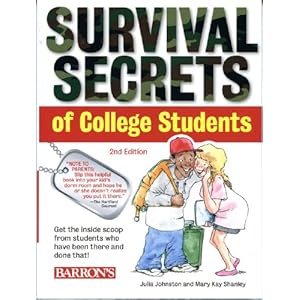
Many parents found this book's previous edition perfect for giving to their college-bound sons and daughters. They recognized it as a reliable source of solid advice, served up in an easy-to-read style. The new second edition has been updated and expanded with more advice and information than ever. One of the authors' most important nuggets of advice is, "Don't think of college as a party place away from home; think of it as the place where you get ready for the rest of your life." They go on to advise students on how to--
- Cope with that less-than-perfect roommate
- Balance time between study, work, and leisure
- Deal with homesickness and make new friends
- Beat test deadlines and study smart
- Handle heavy course loads
- Avoid alcohol and drug culture pitfalls
Every chapter in this book rings with authenticity, and includes quotations from students who have been there, done that, and have come through with flying colors. Enhanced with cartoon-style line art.
My Take on the Book
I am always looking for books that make the transition to college that much easier. This book does a great job at providing the facts to any college student, helping them weed through all of the things that they may encounter in college and providing solutions on how to handle them as well as giving some great advice on things to do and resources to connect with in college. I loved how the book was so easy to read and was made to be able to be picked up anywhere and no matter where you open you will find great content. This is definitely not a book that has to be read in a linear fashion. On the contrary, the book is set up just the opposite and I found myself turning from here to there without any concern over where I was going and still had a blast. I will say that if you do start from start to finish it probably makes the most sense, but you do not have to. This is definitely a book that would be a great book for any college student as it provides great advice that a college student can use to be more successful in college!
All opinions expressed in this review are my own and not influenced in any way by the company. Any product claim, statistic, quote or other representation about a product or service should be verified with the manufacturer or provider. Please refer to this site's Disclaimer for more information. I have been compensated or given a product free of charge, but that does not impact my views or opinions.
Monday, May 7, 2012
Book Review - If I Knew Then, What I Know Now! College and Financial Aid Planning From A Parent's Perspective

College and the financial aid planning process should start as early in a child’s life as possible. It can be a frustrating and complicated puzzle, and parents often have no idea where to begin or how to help their children get through it.
If I Knew Then What I Know Now! College & Financial Aid Planning From A Parent’s Perspective (Pendium Publishing) by Cynthia Hammond Davis, is the true story of her struggle to find help putting all of the pieces of the college search, financial aid, scholarships, athletics and extracurricular activities together.
After experiencing first-hand how complex this journey can be, Davis decided to combine her findings and include them in a book to help other parents and students with early college awareness. This book acts as a priceless guide to help parents understand their role as well as offering basic tips on how they can assist their children through the process as efficiently as possible.
Want to know where a lot of scholarship money can be found? Want to find out how your child may be able to attend an out-of-state college while paying in-state tuition costs? Want advice that will save time during the college admission process? Answers to these questions and more can be found in this book – outlined in a short, simple, and to the point approach.
Davis believes that there is nothing to prepare parents on how and where to begin and they struggle through trying to help their children, just as she did, and it was through trial and error she learned how to get to the right information. In her instructive book, she is very candid about mistakes she made along the way in hopes of helping other parents avoid making those same mistakes.
Cynthia Hammond Davis is a College and Career Advisor, Founder/Executive Director of The Light of the City, Inc., a nonprofit organization, and President of CollegeAndCareerAdvice.Com. She is the radio talk show host of her own Saturday morning talk show, “The College and Career Information Hour,” and an in-demand public and motivational speaker.
As a college and financial aid advisor since 2001, she has helped many parents and students get through the process, resulting in their receiving scholarship offers that total over $1 million collectively each year. What Cynthia Hammond Davis does, she does with the passion of someone who truly cares about her work and about helping students to become tomorrow’s professionals.
College is one of the most expensive things parents can plan for their children and now they don’t have to waste countless hours doing their own research – Davis has done it for them. All they need to do is read the book!
My Take on the Book
As a college admissions professional, I have read many books and written one myself, so I am always looking for other books that will make the college selection and planning process easier for parents and children alike. This was a great book that brought together the great experience of the author with practical tips that can help many parents to de-mystify the college preparation process. There are some wonderful hidden gems within the book, and what is best is that the book itself is short and to the point so you are not having to sift through 300-400 pages trying to find exactly what you need, but instead the book is laid out in an easy to follow and understand way that makes perfect sense! All-in-all this was a great book for anyone looking to start the college planning process.
All opinions expressed in this review are my own and not influenced in any way by the company. Any product claim, statistic, quote or other representation about a product or service should be verified with the manufacturer or provider. Please refer to this site's Disclaimer for more information. I have been compensated or given a product free of charge, but that does not impact my views or opinions
Friday, May 4, 2012
Book Review - Say This, NOT That to Your Professor

A Washington college professor is shaking up the world of education and helping students get better grades like never before. Using a progressive teaching style that breaks down barriers, Ellen Bremen, a tenured professor of Communication Studies at Highline Community College just outside of Seattle, Washington is teaching students things that no one ever dreamed of telling students before.
“Succeeding in college,” she says, “is not just about studying day and night to get good grades on the tests. The real key is learning how to talk with professors, so that you express exactly what you need in order to learn, and then deliver what they are asking for. Communicate your goals and intentions, not your remorse. ”
Students wonder, "How can I get better grades?" Many students go all the way through college and never figure out that what they really need to learn is how to effectively and professionally communicate with professors, people who work in the institutions, and other students.
In reality, most professors feel frustrated by the way students bungle communication over class-related issues. Sadly, those same professors won’t take the time or believe it is their responsibility to enlighten students about how the interaction could have been improved.
Ellen Bremen’s amazing new book Say This, NOT That to Your Professor: 36 Talking Tips for College Success cuts through the fog and offers up hard hitting advice and tactics that focus directly on exactly what students must say in the encounters they have at school. Ellen Bremen, in fact, makes it easy by telling them exactly what to say… and what not to say. Here are just some of the numerous, invaluable golden nuggets of advice contained in her book:
“It's not what you do! It's what you say and what you don't say.”
On day ONE after you've gone over the syllabus and any introductory material, go right up to the professor and say, "I am trying to get an A (or B, C, whatever) in this class. Can I meet with you to create a plan?"
During the meeting: You say "Do you review work in advance? How early would you like me to submit that? How would you like me to turn it in? Can I deliver it in person? Or by e-mail?
As the term continues: "I would like to meet with you to discuss how my grades are going.” Or “Do I have any missing grades?” Or, well in advance of the term ending—not a week before the term ends: “I’m at a 2.5 and striving for a 3.0. I’ve calculated that if I achieve ____ on these upcoming assignments, I can achieve this goal. Can we schedule some checkpoints to see how I’m doing?”
Too few students even check their grades during the term! What if your professor accidentally transposed a number or, worse, entered a zero?
What should students never say?
"Why'd you GIVE me that grade?" (Grades are earned, never given!)
"But I worked SO hard!" (Your prof can't grade you for effort... unfortunately)
"I really NEEDED to get a 4.0 in this class!"... in week 10 (Then you should have had a grade goal conversation in week 1 when you and your prof could have actually hatched a plan!).
How do students handle the two peskiest, but common, everyday college issues? Late work and absences!
Use a Three Step Approach:
- Know your prof's policy ahead of time by reading the syllabus;
- Formulate your own plan based on the policy and figure out if you can stomach the existing penalty/consequences;
- Approach your prof with a proactive proposal: "Professor, I've had a situation arise that caused me to be late with my work/absent. This was unavoidable. I reviewed the syllabus and understand that I will face __________ penalty. I've figured out how this affects my standing in the class. I see that you covered Chapter 6 and 7, and I will be responsible for those on my own. I will have my assignment to you on X date. Are you comfortable with this timeline/plan?"
Never ask your prof to go over everything you missed. You wouldn't ask your clergy to redo a sermon for you in your living room, right?
Don't force your prof to be reactive. You have a far better chance for a creative solution and for latitude if you are proactive!
How to not make your professors cringe: Two common clueless statements students make:
"Did I miss anything important today?” Hours of research and planning goes into prepping for a class session. Even days that may seem "boring" or uneventful are taken seriously by your prof.
Instead, say this:
"Professor, I have to miss next Thursday and I apologize for that. I've tried to keep my absences to a minimum (only say this if it's true). I looked at the schedule and I see you're covering Chapter 11 that night. I know we're taking our quiz a few days later. I believe I'll be able to stay on track. Is there anything I'm not thinking about that may be covered? I'd be glad to do the research on my own or ask a classmate to help me with notes."
“Will this be on the test?” Look at the title of your course. There is bound to be material that will be on a test, and some that won't be on a test. But, really, if you walked in on the first day of class and your prof said, "Okay, class, everything you need to know is on page 4, 8, 12, 15, 16-19, 22, 24, 30, 35-42, and review all of the chapters in section 3 of your text. You can leave now," would you really be happy? Believe it or not, you wouldn't feel like you were learning very much.... and you'd feel short-changed in your education.
Instead, say this: "Professor, I see we have a couple of major tests coming up. I'll be working on my own study guides, but I'm also wondering if you'll be giving us a study guide or offering a review session in class?"
How students can survive the things professors do wrong
"This class is boring!" Students have a right to be engaged in their classes, even if they don't feel entertained. What can you do? Talk to the prof privately and say, "I'm struggling with the format of this class." (Often lecture format is the culprit). Then, make some concrete suggestions:
"Could we:
-allow some group discussion?
-add a question-and-answer period after each section?
-ask questions during your lecture? (most profs will take questions during a lecture, but the prof could possibly add questions or quick "are you getting it?" checks into the PowerPoint material)
-submit anonymous questions before class that you can answer during class?
-do activities related to the material?
-assign a section to students and allowing them to present the material?
-or any of your own ideas ... think of a teacher whose class you enjoyed and in which you learned a great deal
And there’s much more. Say This, NOT That to Your Professor is the first book that is totally devoted to the student-prof dynamic.
Students work with professors every single day and yet there is no readily available handbook available anywhere that takes the mystery out of how to behave so you achieve success on campus.
This book tells students exactly the words to say in person. There is no alternative that is effective. The students can't text it in, Facebook it in, or even phone it in with professors. Like it or not, most of the essential communication that leads to success in college has to be done face-to-face.

A 14-year classroom veteran, Ellen Bremen is tenured faculty in the Communication Studies department at Highline Community College. She has previously taught at Darton College, University of Nevada Las Vegas, and the College of Southern Nevada.
Ellen has received national recognition for teaching innovation by the Sloan-Consortium (2011), the National Institute for Staff and Organizational Development and the National Council of Instructional Administrators (2003). She received degrees in Post-Secondary Education and Communication. Ellen blogs as The Chatty Professor.
My Take on the Book
As someone that has worked in higher education for some time, I can honestly say that this book does offer some great insights into what you should and should not do when it comes to interacting with your professors. Some of the points are common sense (if you have attended college in the past), but there are also some real hidden gems in the book as well which made me say, yes, this author really know what she is talking about. What I loved most about the book was that the author is a professor and she is sharing her own experiences in the classroom with the reader, and this type of experience is so valuable for all readers to know as it is this experience that makes the book as valuable as it is. The book has a light tone, but it is very heavy in details and information and is truly a resource that any current college student or soon-to-be college student should read!
All opinions expressed in this review are my own and not influenced in any way by the company. Any product claim, statistic, quote or other representation about a product or service should be verified with the manufacturer or provider. Please refer to this site's Disclaimer for more information. I have been compensated or given a product free of charge, but that does not impact my views or opinions.
Wednesday, May 2, 2012
Tips for Parents and Students for College ACT Test Success from Virtual Nerd Expert Tutor Leo Shmuylovich
The ACT college entrance exam is is administered many times throughout the year and many students are feeling extremely pressured as this test can be the deciding factor as to which college or university they will attend. Test-taking anxiety and high stress levels are common this time of year and expert tutor and co-founder of the “Parent Tested Parent Approved” interactive tutoring website Virtual Nerd, Leo Shmuylovich, is here to help.
Leo offers the following steps for successful ACT testing:
1) GUESSING IS OK - First and foremost, remember that there is NO PENALTY for guessing. No matter what, make sure you at fill in a bubble for every single question. That means you have to make sure that you leave yourself enough time to bubble in an answer on every question (even the ones you didn't have time to read).
2) ELIMINATE WRONG ANSWERS- You’ll have a better chance at guessing right if you first eliminate some answers, so when you a read a question, read the answers too! You’ll be surprised how many answers you can eliminate if you just take the time to read them over and apply them to the problem. Process of elimination is a technique that tutors really focus on for ACT and SAT.
3) PLUG ANSWERS CHOICES INTO THE QUESTION - One way to get intuition about eliminating answer choices is to plug in every single answer in a math problem and check to see if it works. So if the problem is asking you to solve for a variable in an equation, just plug in the different answers and the one that works is the right answer! When you’re taking the test there are some tricks to plugging in the answer choices, and ACT tutors love teaching those to students. The key though is to get comfortable working with the answer choices, because then you’re not just taking the test, but you’re taking the test apart!
4) FOCUS ON CHARTS AND DIAGRAMS - Diagrams and charts are also really important parts of the ACT. If you have a geometry problem without a diagram, then drawing one yourself, and keeping it to scale, can be a great trick for quickly figuring out the problem. If there is a diagram already drawn, use the diagram to estimate what they’re asking about. On the ACT, diagrams are almost always to scale. When you see a chart or graph, especially in the science section, you should get excited, because for the most part the problems in that section will be based completely on just interpreting the chart or the graph. You can basically skip the written description! ACT tutors often tell their students that 1/3 of the science section can be completely mastered if you just get good at interpreting charts and graphs. So when you’re practicing the science section, focus on charts!
5) TIME MANAGEMENT IS KEY - There are also some tips to keep in mind for time-management. One of the best things for time management is to stay calm as you take the test, and that’s why I always recommend that students practice without time restrictions. That way they are able to focus on the test and can overcome their fear of it. Then, we can add time pressure back in gradually, and that helps deal with issues of time management. Also, it’s a good idea to skip around the test, and pick off the questions that are easiest for you to do. If something is taking too long, try to eliminate an answer choice and just move on to other stuff. You can always come back at the end, and remember, don’t leave any question behind, bubble in every question!
6) SEEK HELP IN WEAK AREAS- So far these tips have been all about cracking the test, dissecting it and using its tricks and structure to your advantage. It’s important to remember though that the test does rely on some basic math and science knowledge. As you practice taking tests, keep track of the problems that you find confusing, problems where the math was tricky or hard to remember. Make sure you seek out help for those topics, and strengthen your math and science foundations. Tutors and teachers can help you with this, and a lot of online resources exist as well that can help you strengthen your fundamentals and be fully prepared for the ACT!
ABOUT LEO
Leo Shmuylovich just completed his Ph.D in Physics from Washington University in St. Louis. He is currently on a year leave from medical school to help launch the company he co-founded, Virtual Nerd (http://www.virtualnerd.com/). He has a B.S. in Chemical Engineering from Cornell University, having graduated Magna Cum Laude in three years—and he was named a Merrill Presidential Scholar, one of the university’s highest honors. As a tutor and lecturer for The Princeton Review, he taught MCAT Physics and Biology classes, as well as SAT Math classes, to hundreds of students. He’s also worked individually with students on SAT, SAT II, AP exams, and science and math courses at both the high school and college level.
FACTS ABOUT THE ACT http://www.act.org/news/aapfacts.html
All opinions expressed in this review are my own and not influenced in any way by the company. Any product claim, statistic, quote or other representation about a product or service should be verified with the manufacturer or provider. Please refer to this site's Terms of Use for more information. I have been compensated or given a product free of charge, but that does not impact my views or opinions.
1) GUESSING IS OK - First and foremost, remember that there is NO PENALTY for guessing. No matter what, make sure you at fill in a bubble for every single question. That means you have to make sure that you leave yourself enough time to bubble in an answer on every question (even the ones you didn't have time to read).
2) ELIMINATE WRONG ANSWERS- You’ll have a better chance at guessing right if you first eliminate some answers, so when you a read a question, read the answers too! You’ll be surprised how many answers you can eliminate if you just take the time to read them over and apply them to the problem. Process of elimination is a technique that tutors really focus on for ACT and SAT.
3) PLUG ANSWERS CHOICES INTO THE QUESTION - One way to get intuition about eliminating answer choices is to plug in every single answer in a math problem and check to see if it works. So if the problem is asking you to solve for a variable in an equation, just plug in the different answers and the one that works is the right answer! When you’re taking the test there are some tricks to plugging in the answer choices, and ACT tutors love teaching those to students. The key though is to get comfortable working with the answer choices, because then you’re not just taking the test, but you’re taking the test apart!
4) FOCUS ON CHARTS AND DIAGRAMS - Diagrams and charts are also really important parts of the ACT. If you have a geometry problem without a diagram, then drawing one yourself, and keeping it to scale, can be a great trick for quickly figuring out the problem. If there is a diagram already drawn, use the diagram to estimate what they’re asking about. On the ACT, diagrams are almost always to scale. When you see a chart or graph, especially in the science section, you should get excited, because for the most part the problems in that section will be based completely on just interpreting the chart or the graph. You can basically skip the written description! ACT tutors often tell their students that 1/3 of the science section can be completely mastered if you just get good at interpreting charts and graphs. So when you’re practicing the science section, focus on charts!
5) TIME MANAGEMENT IS KEY - There are also some tips to keep in mind for time-management. One of the best things for time management is to stay calm as you take the test, and that’s why I always recommend that students practice without time restrictions. That way they are able to focus on the test and can overcome their fear of it. Then, we can add time pressure back in gradually, and that helps deal with issues of time management. Also, it’s a good idea to skip around the test, and pick off the questions that are easiest for you to do. If something is taking too long, try to eliminate an answer choice and just move on to other stuff. You can always come back at the end, and remember, don’t leave any question behind, bubble in every question!
6) SEEK HELP IN WEAK AREAS- So far these tips have been all about cracking the test, dissecting it and using its tricks and structure to your advantage. It’s important to remember though that the test does rely on some basic math and science knowledge. As you practice taking tests, keep track of the problems that you find confusing, problems where the math was tricky or hard to remember. Make sure you seek out help for those topics, and strengthen your math and science foundations. Tutors and teachers can help you with this, and a lot of online resources exist as well that can help you strengthen your fundamentals and be fully prepared for the ACT!
ABOUT LEO
Leo Shmuylovich just completed his Ph.D in Physics from Washington University in St. Louis. He is currently on a year leave from medical school to help launch the company he co-founded, Virtual Nerd (http://www.virtualnerd.com/). He has a B.S. in Chemical Engineering from Cornell University, having graduated Magna Cum Laude in three years—and he was named a Merrill Presidential Scholar, one of the university’s highest honors. As a tutor and lecturer for The Princeton Review, he taught MCAT Physics and Biology classes, as well as SAT Math classes, to hundreds of students. He’s also worked individually with students on SAT, SAT II, AP exams, and science and math courses at both the high school and college level.
FACTS ABOUT THE ACT http://www.act.org/news/aapfacts.html
All opinions expressed in this review are my own and not influenced in any way by the company. Any product claim, statistic, quote or other representation about a product or service should be verified with the manufacturer or provider. Please refer to this site's Terms of Use for more information. I have been compensated or given a product free of charge, but that does not impact my views or opinions.
Tuesday, May 1, 2012
Book Review - The College Roommate from Hell — Skills and Strategies for Surviving With a Problem Roommate

About the Book
All across the country, incoming college freshman are getting ready to move away from home for the first time. For many of these new college students, moving away from home means living with a roommate for the first time as well. Some students choose to live on-campus, while others choose off-campus housing. With either scenario, living with a roommate is a big adjustment.
Of course, every incoming freshman hopes to find a friend as his or her roommate, but not every situation will be ideal. A lot of problems may occur because both roommates simply need to take the time to understand one another. Moving away from home for the first time is exciting but is also a big change. Taking the time to resolves issues between you and your roommate can positively affect your transition to college.
If you find yourself not getting along with a roommate or you want to learn more about coping with a roommate before moving away, at Atlantic Publishing Company, we have a book for that.
The College Roommate From Hell — Skills and Strategies for Surviving With a Problem Roommate covers everything you need to know about how to understand and fix any problems with a troublesome roommate. This comprehensive guide will teach you what to expect before moving, how to approach your roommate once you move in, roommate survival skills, cultural and social differences, how to deal with a serious problem, and how to understand a spectrum of personalities.
This book includes interviews with students that had roommate problems and discusses how they were solved. Before giving up on your roommate and spending a semester or more in an undesirable situation, read The College Roommate From Hell. After doing so, you will know you are not alone, have viable strategies for dealing with problems, and feel more comfortable approaching any issue you may have with a roommate.
All across the country, incoming college freshman are getting ready to move away from home for the first time. For many of these new college students, moving away from home means living with a roommate for the first time as well. Some students choose to live on-campus, while others choose off-campus housing. With either scenario, living with a roommate is a big adjustment.
Of course, every incoming freshman hopes to find a friend as his or her roommate, but not every situation will be ideal. A lot of problems may occur because both roommates simply need to take the time to understand one another. Moving away from home for the first time is exciting but is also a big change. Taking the time to resolves issues between you and your roommate can positively affect your transition to college.
If you find yourself not getting along with a roommate or you want to learn more about coping with a roommate before moving away, at Atlantic Publishing Company, we have a book for that.
The College Roommate From Hell — Skills and Strategies for Surviving With a Problem Roommate covers everything you need to know about how to understand and fix any problems with a troublesome roommate. This comprehensive guide will teach you what to expect before moving, how to approach your roommate once you move in, roommate survival skills, cultural and social differences, how to deal with a serious problem, and how to understand a spectrum of personalities.
This book includes interviews with students that had roommate problems and discusses how they were solved. Before giving up on your roommate and spending a semester or more in an undesirable situation, read The College Roommate From Hell. After doing so, you will know you are not alone, have viable strategies for dealing with problems, and feel more comfortable approaching any issue you may have with a roommate.
My Take on the Book
As a person who has worked in residence life on a college campus this book covers many of the common problems that students who have roommates face while in college and beyond. What was nice about the book though was that it provided the reader with practical tips to work on turning around roommate relationships toward positive outcomes. The reason I like this is that every housing staff member is taught to help roommates to work through their conflicts and not to just move roommate assignments, so it is to the benefit of all who are going to be having a roommate to read this and learn some of the things that might drive you nuts and how to deal with them.
As a person who has worked in residence life on a college campus this book covers many of the common problems that students who have roommates face while in college and beyond. What was nice about the book though was that it provided the reader with practical tips to work on turning around roommate relationships toward positive outcomes. The reason I like this is that every housing staff member is taught to help roommates to work through their conflicts and not to just move roommate assignments, so it is to the benefit of all who are going to be having a roommate to read this and learn some of the things that might drive you nuts and how to deal with them.
I could tell by reading through this book that it would have helped many past college students that had to deal with challenging roommate situations. Full of great resources and appendices, the book was an easy, instructional read that would be a great gift for the new college student (but they need to read it!).

All opinions expressed in this review are my own and not influenced in any way by the company. Any product claim, statistic, quote or other representation about a product or service should be verified with the manufacturer or provider. Please refer to this site's Terms of Use for more information. I have been compensated or given a product free of charge, but that does not impact my views or opinions.
Monday, April 30, 2012
Introducing ScholarGamers.com: Paying for College Has Never Been So Much Fun

The first in a planned series of sponsor-supported platforms by Internet Sport Games Associates (ISGA), ScholarGamers.com is the brainchild of marketing executive Angelo Tartaro. Recognizing the increasing popularity of casual online games among middle- and high-school students, a demographic which will also bear the burden of skyrocketing educational costs, Tartaro assembled a team of marketing, technology and video game professionals to develop the ScholarGamers.com solution.
“With the average annual cost of a college education exceeding $30,000, and the average debt load of a college graduate exceeding $20,000, a college degree is a significant financial burden,” said Tartaro. “We’re aiming to make that goal more attainable for kids who aren’t necessarily the star athletes or valedictorians, by leveraging one of their favorite pastimes for educational purposes.”
“ScholarGamers.com provides advertisers with a unique opportunity to engage with a coveted demographic of teens and their parents in a wholesome and educational context.”
Funded by carefully-vetted advertising and sponsorship of competitions, ScholarGamers.com is at the nexus of several of fastest growing areas online—including casual games and social gaming. Comscore reports that online games are growing at ten times the rate of the total U.S. Internet population and reach nearly one out of every two Internet users, while NPD Group reports that the percentage of online gamers ages 13-17 increased from 17 percent in 2008 to 22 percent in 2009. Marketer forecasts that advertising in online games will increase 133% from 2007 to 2012.
“Studies show when played in moderation, online games can offer many benefits–building self-esteem, fostering camaraderie, and developing motor and problem-solving skills,” said Tartaro. “By adding purpose to the games, ScholarGamers.com enhances the positive experience.”
About ScholarGamers.com
ScholarGamers.com is an innovative platform offering middle- and high-school youths ages 13 and above a chance to compete for educational scholarships through no-fee online games. Simple in concept and elaborate in reward, ScholarGamers.com doesn’t limit scholarships to those with the usual special skills. Developed as a response to escalating educational costs, ScholarGamers.com’s secure environment fosters a sense of pride, accomplishment and fun. The site is the first in a planned series of sponsor-supported initiatives developed by Holmdel, NJ-based Internet Sport Games Associates. For more information, please visit www.scholargamers.com. Follow us on Facebook and Twitter.
Sunday, April 29, 2012
Fiske Interactive - A College Guide for the iPad
For more than 25 years, millions of parents, counselors, and college-bound students have turned to The Fiske Guide to Colleges for an independent perspective on the distinctive personalities of the best and most interesting colleges and universities in the U.S., Canada, and Great Britain.
Now, the Fiske Interactive College Guide brings you every aspect of the book—plus much more—in an app!
Check out the video! (It’s only 78 seconds long) http://www.sourcebooks.com/
Fiske Interactive allows you to go beyond the book and streamline your college search with the following resources and tools:
- Plan your college tour with built-in Google map function
- Find school deadlines and application dates
- Email admissions departments directly from the app
- Browse each college website
- Check out comparable campuses (“overlap schools”)
Fiske Interactive also allows parents and students to quickly and easily organize their top choices using lists and notes:
- Flag schools for a second look
- Categorize the schools you are interested in by using the “Safety Schools,” “Probable Schools,” and “Reach Schools” list feature
- Add notes to each school
Fiske Interactive includes the hallmark Fiske Profiles that provide a candid, authoritative look at the academic climates and extracurricular scenes of 310+ colleges and universities. The app allows you to browse through the guide with a swipe of your finger, view photos of each campus, or search by your chosen criteria, including state, campus location, enrollment size, academic program, Fiske rating, or just a keyword.
It’s the next best thing to being on campus.
You’ll quickly find the Fiske Interactive College Guide to be your most trusted, on-the-go companion, bringing much-needed calm and sanity to one of the most important decisions you’ll ever make.
Fiske Interactive ($19.99) is available exclusively for the iPad.
All opinions expressed in this review are my own and not influenced in any way by the company. Any product claim, statistic, quote or other representation about a product or service should be verified with the manufacturer or provider. Please refer to this site's Disclaimer for more information. I have been compensated or given a product free of charge, but that does not impact my views or opinions.
Saturday, April 28, 2012
Summer Tips for High Schools Grads and Their Parents from Top College Expert
Every summer before the start of college, nationally syndicated advice columnist Harlan Cohen gets a flood of letters from students sharing their deepest fears and anxieties.
Rarely do these soon-to-be college freshmen share these feelings with their parents.
Harlan, author of the bestselling college guide The Naked Roommate and parent college guide The Happiest Kid on Campus
 , says parents can and should be communicating with their college-bound kids this summer – just don’t grill them with 20 questions while playing Jeopardy music in the background (way too much pressure).
and parent college guide The Happiest Kid on Campus, says parents can and should be communicating with their college-bound kids this summer – just don’t grill them with 20 questions while playing Jeopardy music in the background (way too much pressure).
Instead, Harlan suggests parents plan a comfortable time to talk (weekend road trip, shopping trip, manicure, ballgame) and get students thinking about some of the big changes ahead.
Five Questions For Summer College Prep
2. How do you plan on making this happen? Try to get your son or daughter thinking about the activities, organizations, and opportunities available outside the classroom that help make them find connections to campus life.
3. Who are the people on campus who can help? Have them think of five types of people who they can turn to for advice. These should be people who want them to win.
4. How much time are you going to give yourself to make it ALL happen? Plant the seed that it can take a couple of years – not weeks or months – to make it happen. Help them set a realistic timeline, otherwise they’ll be set up for disappointment.
5. What can I do to help? By asking, this sends a message that you are willing to help, but don’t assume they will need your help. Then go make plans to send lots of care packages (STUDENTS LOVE CARE PACKAGES)
Harlan Cohen is a bestselling author, nationally syndicated advice columnist (Help Me, Harlan!) and professional speaker who has visited over 400 college campuses. He has been featured as an expert in The New York Times, The Washington Post, The Boston Globe and The Wall Street Journal Classroom Edition, and has been a guest on numerous radio and television shows, including NBC’s Today Show.
All opinions expressed in this review are my own and not influenced in any way by the company. Any product claim, statistic, quote or other representation about a product or service should be verified with the manufacturer or provider. Please refer to this site's Disclaimer for more information. I have been compensated or given a product free of charge, but that does not impact my views or opinions.
Friday, April 27, 2012
Book Review - How to Write a Killer SAT Essay

The only book with dozens of top-scoring REAL SAT essays from REAL students
About the Author
Tom Clements, a father of four daughters who attended Ivy League undergraduate and graduate schools with his help, has spent over 20 years of his life tutoring for the SATS, as well as calculus, physics, and chemistry. A former Silicon Valley freelance writer for tech magazines, corporate trainer for international bankers, and former college English teacher, Clements holds a Masters of International Business degree from St. Mary’s College and a BA in English Literature. His new book, How to Write a KILLER SAT Essay ...in 25 Minutes or Less!, is available for purchase at Amazon.com
 . Or you may visit the author’s website, www.tctutoring.net, or visit Killer SAT on Facebook or more information.
My Take on the Book
As someone who has worked in the College Admissions field for a number of years I have to say that this was a very well-written book that was written at the level for any teenager to follow and understand. I loved the number of examples that the author provides within the text and he makes it very simple for the reader to grasp the concepts that he is sharing. What he also does within this book is he shares his thoughts in a fun, down-to-earth way that a teenager will relate to. He does not pontificate and share a list of do this and not that, but instead gives clear instruction and examples to help any reader with making their SAT Essay that much stronger. This was a great book that I would highly recommend to any teenager preparing for the SAT, as this will put your mind at ease and help you to be ready to ace the writing portion of the test!
All opinions expressed in this review are my own and not influenced in any way by the company. Any product claim, statistic, quote or other representation about a product or service should be verified with the manufacturer or provider. Please refer to this site's Disclaimer for more information. I have been compensated or given a product free of charge, but that does not impact my views or opinions.
Subscribe to:
Posts (Atom)
